It was a quiet day, the kind when the sun filters gently through olive trees and time seems to stand still. The Apostle that Jesus loved was surely there amongst the other disciples, not in fear or confusion this time, but in solemn peace. Mary, the Mother of Jesus, was nearing the end of her earthly journey. She wasn’t sick in the way we think of illness. Rather, her soul seemed to be gradually ascending even before her body left the earth—drawn upward by love, her mission fulfilled, her heart at rest.
This is how tradition imagines the “Good Death” of Mary—not marked by agony or despair, but by peace, readiness, and reunion. It wasn’t a moment to be feared. It was a homecoming.
A Death That Was Really a Rising
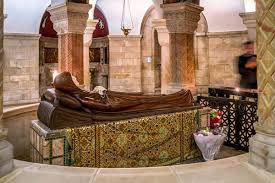
August is the month of the Assumption, when the Church celebrates that Mary was taken body and soul into Heaven. Yet before the glory of the Assumption came a moment of letting go—a death, or as the Eastern Church beautifully calls it, the Dormition, the “falling asleep” of the Mother of God.
It’s not hard to imagine what that last day may have looked like. Mary, now aged, worn not by sin but by love, surrounded by those who had walked with her Son. Her face serene. Her eyes still carrying the memory of Calvary and the empty tomb. And in her heart? Peace. No clinging to the world. No fear of what lay ahead. Just a quiet readiness.
For those of us still making our way through the troubles and trials of life, Mary’s death offers a kind of map—not just for how to die, but for how to live.
Living Like Mary, So We May Die Like Mary
Mary’s “yes” to the angel long ago wasn’t a one-time event. It echoed through her entire life. When she fled with Joseph to Egypt. When she searched anxiously for the boy Jesus in the Temple. When she stood at the foot of the Cross. And when she waited in the Upper Room for the Holy Spirit to come.
Her life was one long surrender. And in that surrender, she was not diminished—she was magnified.
What made her death “good” was that she had already died many times before—to her own plans, her own comfort, her own fears. That’s what made her ready. That’s what gave her death its dignity, and her Assumption its glory.
A Familiar Message from Fatima
In a very real way, the events of Fatima in 1917 echoed this truth. When Our Lady appeared to the three shepherd children, her words were simple but urgent: “Do you wish to offer yourselves to God?” She didn’t ask them merely to believe—she asked them to live like her.
Lucia, Francisco, and Jacinta didn’t fully understand what they were agreeing to. But they said yes. And that “yes” changed their lives. Francisco and Jacinta would die just a few years later—young, but prepared. Like Mary, they died with peace because they had lived with purpose.
Fatima is not just about praying the Rosary or wearing a scapular. It’s about shaping our whole life around one question: Am I preparing to see God face to face?
Preparing for Our Own “Assumption”
We may not be taken body and soul into Heaven like Mary, but we are all destined to meet God. How we live now prepares us for how we will leave this world.
Mary teaches us to:
- Embrace silence in a noisy world. Like her, we can learn to “ponder things in our hearts.”
- Let go of attachments—to possessions, to control, even to our plans.
- Trust God, especially in suffering, knowing that the Cross is never the end.
- Live for Heaven, not for applause or comfort, but for eternal joy.
In the end, Mary’s life shows us that a good death is the result of a good life—one rooted in humility, faith, and love.
A Story That Continues in Us
As we contemplate Mary’s good death and glorious Assumption, we are invited to see our own lives as part of that same journey.
Perhaps the question isn’t “How will I die?” but “Am I living in such a way that my death, whenever it comes, will be a rising?”
The Fatima message gives us the tools. Daily Rosary. Reparation. Consecration to Mary. Living each day in grace. All these practices are not just devotions—they are steps toward eternity.
In the end, we will each have our own moment of letting go. May it be like Mary’s—a gentle falling asleep in the arms of the One who loves us.
And until then, may we walk with her, contemplating the path she walked so that we may follow in her footsteps—all the way home.


Leave a Reply to Edward Cancel reply