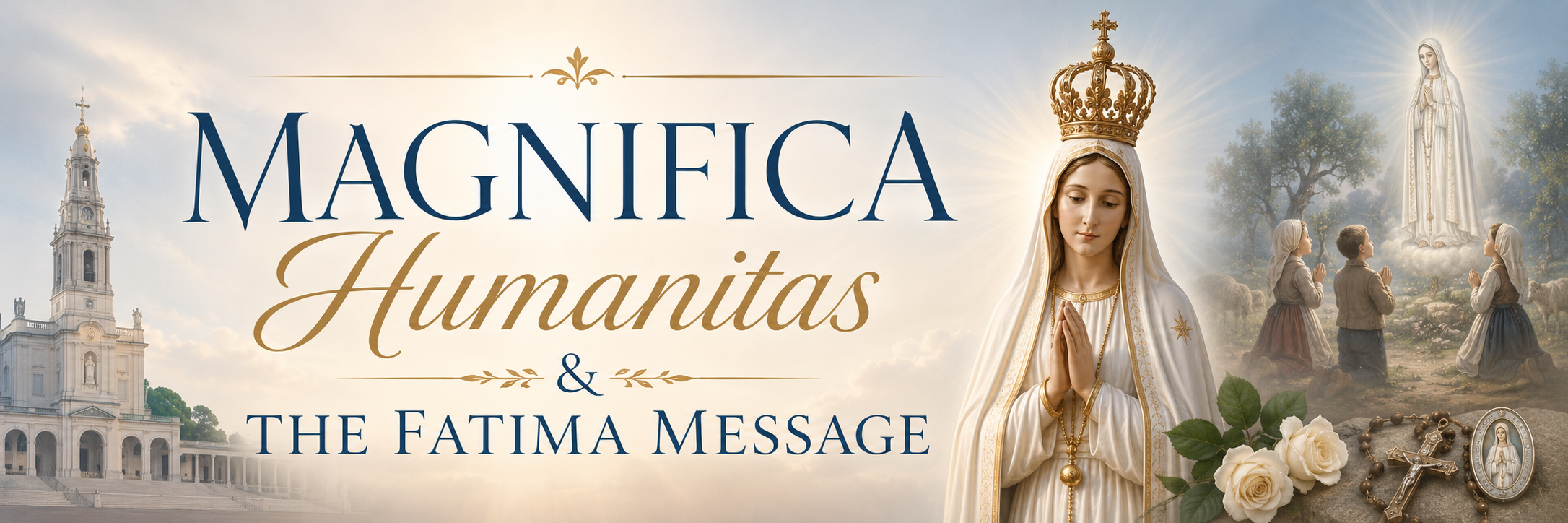
Magnifica Humanitas & the Fatima Message
Pope Leo XIV’s Encyclical on the Human Person in the Age of Artificial Intelligence
Published · May 2026 · World Apostolate of Fatima, Goa
Part One
A Marian Light on a Digital Age
Pope Leo XIV closes his landmark encyclical not with statistics or policy, but with the Magnificat — Mary’s own canticle of hope. This is no accident. The entire document breathes a Marian spirit, and for the World Apostolate of Fatima, it carries unmistakable echoes of Our Lady’s message at Cova da Iria.
The Pope’s urgent plea to remain profoundly human in an age of dehumanising technology finds its perfect model in Mary — the fully human person who said an unconditional yes to God, untouched by pride, power or self-sufficiency. She is the living antidote to what Leo XIV calls the “Babel syndrome.”
More striking still, the encyclical warns of concentrated power, the erosion of truth, the normalisation of war, and the spiritual roots of civilisational collapse — the very realities Our Lady of Fatima addressed over a century ago. WAF can say with confidence: Fatima was prophetic. The requests for prayer, penance, reparation, and conversion are precisely the “shared spiritual discernment” the Pope now calls the whole world to embrace.
The First Saturday devotion, far from being a private piety, is an act of co-redemptive love that repairs what the builders of Babel destroy. As the Pope speaks of structures of sin embedded in digital and economic systems, WAF’s charism of reparation to the Immaculate Heart becomes not a devotional extra — but a social and spiritual necessity.
Our Lady of Fatima calls us back to the most human thing of all —
a heart that loves, repents, and trusts in God.”
Part Two
The Encyclical in Summary
Released on 15 May 2026, marking the 135th anniversary of Rerum Novarum, Magnifica Humanitas is Pope Leo XIV’s moral roadmap for the digital revolution. Its subtitle says it all: On Safeguarding the Human Person in the Time of Artificial Intelligence.
The Pope frames everything around a biblical choice: the Tower of Babel — built on pride, profit and self-sufficiency — versus Nehemiah’s Jerusalem, rebuilt patiently, prayerfully, and together. He asks: as AI reshapes our world, which are we building?
Babel
Pride. Profit.
Self-sufficiency.
Concentrated power.
Jerusalem
Patient prayer.
Common labour.
God at the centre.
Technology, he insists, is never neutral. It reflects the values of those who create, finance and control it. Today, that control rests increasingly with private transnational corporations whose power exceeds many governments — a grave threat to the common good that every Catholic must take seriously.
Part Three
Catholic Social Principles in Daily Life
For the lay faithful, the encyclical applies the Church’s social principles directly to daily life:
- ❖Human dignity cannot be measured by productivity or efficiency — every person is infinitely loved by God.
- ❖The common good demands we look beyond personal interest.
- ❖The universal destination of goods now extends to algorithms, data and digital platforms, which must serve all, not enrich a few.
- ❖Subsidiarity insists that families, parishes and local communities must have a voice in decisions that shape their lives.
- ❖Solidarity calls us to conscious, neighbour-centred choices — even in how we use technology.
Part Four
Three Urgent Warnings
The Pope warns urgently of three threats facing our time:
- 01The spread of misinformation eroding truth.
- 02Automation displacing workers and stripping work of its dignity.
- 03Addictive digital platforms creating new forms of slavery.
Part Five
Rebuilding Together — Like Nehemiah, Like Mary
His call to action echoes Nehemiah — and Mary at the Upper Room. Like the disciples awaiting Pentecost, we are invited to pray, plan wisely, and rebuild together, placing God at the centre and the human person at the heart of every decision.
Magnificat anima mea Dominum.
My soul magnifies the Lord.
Full Encyclical Text
vatican.va · Magnifica Humanitas (15 May 2026)
From Fatima to Our Times
“In the end, my Immaculate Heart will triumph …”
Our Lady at Fatima · 13 July 1917
Leave a Reply